
Master keyword research strategies for SEO growth in 2026. Learn how to find high-intent long-tail keywords with free tools, build topic clusters, and rank in AI search. Step-by-step guide + checklist.
Why Keyword Research Strategies Have Changed in 2026
Keyword research is still the foundation of SEO — but in 2026 it’s no longer about chasing high-volume head terms. Google’s AI Overviews, Gemini, and generative search now reward intent-driven, long-tail, and semantic keywords that match exactly what users ask.
Short keywords like “SEO” have massive competition and low conversion. Long-tail phrases like “keyword research strategies for SEO growth in 2026 with free tools” have lower search volume but higher buyer intent, better ranking chances, and more AI citations.
Businesses that master modern keyword research strategies see 3–5x more organic traffic with less effort. At PixelPropel, we use this exact approach to help clients in Pakistan and beyond dominate their niches.

AI Keyword Research 2026 Guide – The Future of search engine optimization Strategy
Alt text: AI keyword research 2026 guide illustration showing futuristic SEO strategy with long-tail keywords and semantic search
The Power of Long-Tail Keywords: Lower Competition, Higher Conversions
Long-tail keywords (3+ words) now make up over 70% of all searches. Here’s why they win in 2026:
- Lower competition → Easier to rank in the top 3 positions
- Higher conversion → Users searching long-tail are further down the funnel
- Better for AI search → AI Overviews love specific, question-based phrases
- Topic cluster gold → One long-tail keyword can support 8–12 supporting articles
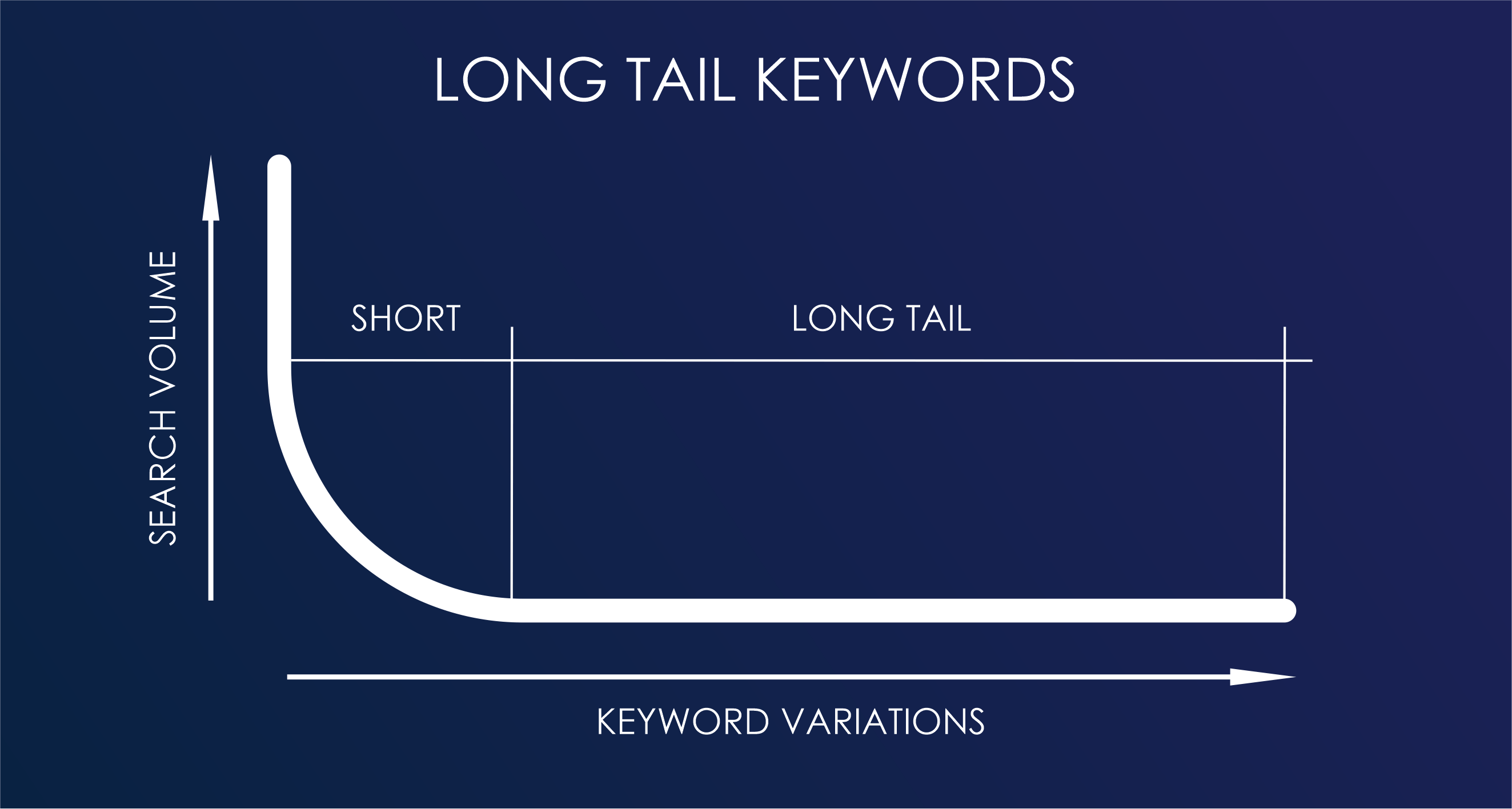
Long-Tail Keywords: What They Are & How to Use Them in 2026
Alt text: Long-tail keywords graph 2026 showing search volume vs keyword length for SEO strategy
Step-by-Step Keyword Research Process for 2026
Follow this proven 6-step process every month:
- Brainstorm Seed Keywords Start with your core topics, services, and customer questions.
- Expand with Free Tools (covered in next section) Find 50–100 related long-tail variations.
- Analyze Search Intent Categorize as informational, navigational, commercial, or transactional.
- Check Metrics
- Search volume (even 10–100/month is valuable)
- Keyword difficulty (aim for KD < 30)
- Click potential & AI Overview opportunity
- Map to Content Group into topic clusters (pillar + cluster pages).
- Track & Refresh Monitor rankings and update quarterly.
Best Free Keyword Research Tools in 2026
You don’t need expensive tools. These free options deliver professional results:
| Tool | Best For | Key 2026 Feature | How We Use It at PixelPropel |
|---|---|---|---|
| Google Keyword Planner | Volume & competition data | AI-suggested long-tail phrases | Seed keyword expansion |
| Google Trends | Seasonal & rising trends | Real-time interest comparison | Validate timely long-tail keywords |
| AnswerThePublic | Question-based long-tail | Visual “wheels” of questions | FAQ and blog topic ideas |
| Google Search Console | Your own site’s performance | Actual search terms driving traffic | Discover hidden long-tail winners |
| Bing Webmaster Tools | Alternative data + AI insights | Free keyword suggestions | Cross-check Google data |
| People Also Ask / Related Searches | Intent & semantic ideas | Direct from Google SERPs | Cluster content planning |
.png)
Long-Tail Keywords: What They Are & How to Use Them in 2026
Alt text: Keywords by search volume chart 2026 showing long-tail keyword distribution for SEO growth
Advanced Strategies: Semantic Search, User Intent & Topic Clusters
- Semantic & Entity Research — Include related entities (people, tools, locations) that Google understands.
- User Intent Matching — Write content that perfectly answers the “why” behind the search.
- Topic Cluster Building — One pillar page + 8–10 long-tail cluster pages creates topical authority.
- Competitor Gap Analysis — Use free tools to find keywords your competitors rank for but you don’t.
- Voice & Conversational Search — Optimize for natural questions (“how to do keyword research in 2026 without paid tools”).
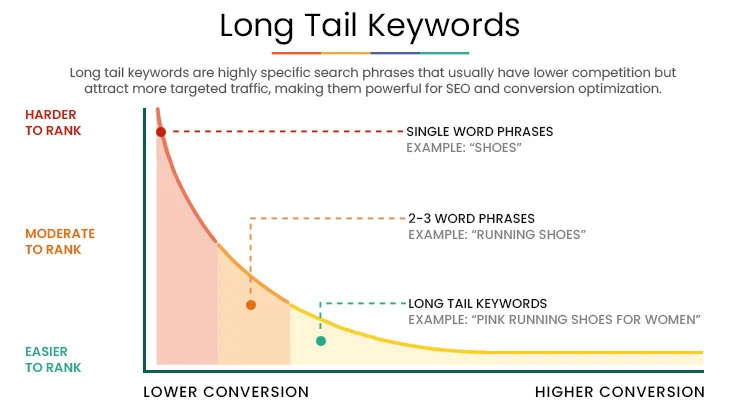
Long-tail keywords: Proven 2025 Strategies
Alt text: Long-tail keywords difficulty vs conversion chart for 2026 SEO strategy
Complete Keyword Research Checklist for SEO Growth
Use this checklist before every new piece of content:
- Primary long-tail keyword in title, H1, first 100 words
- 3–5 secondary long-tail variations naturally used
- Question-based headings (H2/H3)
- Related semantic entities included
- Internal links to pillar/cluster pages
- Schema markup (FAQ or HowTo)
- Content length matches search intent (1500–3000+ words for competitive terms)
- Updated freshness date if stats change
Common Keyword Research Mistakes That Kill Your Rankings
- Focusing only on high-volume keywords
- Ignoring search intent
- Keyword stuffing instead of natural usage
- Never updating your keyword list
- Not tracking real performance in Search Console
Real Results: How Long-Tail Keyword Research Delivered 3x Traffic
One of our e-commerce clients in Lahore implemented this exact long-tail strategy:
- Targeted 45 long-tail keywords with free tools
- Built 12 cluster articles around one pillar page
- Result in 4 months: organic traffic increased 312%, with 68% of new traffic from long-tail phrases.
Similar results happen for service businesses, startups, and local companies when they shift to 2026 keyword research strategies.
Future-Proofing Your Keyword Research Strategy
In 2026 and beyond:
- Prioritize AI-friendly, question-based long-tail keywords
- Combine free tools with manual intent analysis
- Refresh keyword lists every 30–60 days
- Focus on topical authority over single keywords
Conclusion: Start Growing Your SEO Traffic Today
Keyword research strategies in 2026 are simpler and more powerful than ever when you focus on free tools and long-tail keywords. Follow the step-by-step process, checklist, and advanced tactics in this guide to build sustainable SEO growth.
Ready to uncover profitable long-tail keywords for your business?
Contact PixelPropel for a free Keyword Research Audit. We’ll deliver a custom 2026 keyword list + content cluster plan tailored to your niche — absolutely free.
Get Your Free Keyword Research Audit →
Stop guessing what to rank for. Start ranking smarter today.
FAQ: Keyword Research Strategies 2026
Q: Are long-tail keywords still effective in 2026? A: Yes — they are more effective than ever because of lower competition and higher AI citation potential.
Q: What are the best free keyword research tools in 2026? A: Google Keyword Planner, AnswerThePublic, Google Trends, and Google Search Console give professional-level results without any cost.
Q: How many keywords should I target per page? A: One primary long-tail keyword + 3–5 secondary variations. Focus on natural usage and intent.
Q: How often should I do keyword research? A: Monthly for active sites, or quarterly for stable ones. Refresh your list every 30–60 days.
Q: Can small businesses in Pakistan use these strategies? A: Absolutely. The free tools and long-tail focus work globally and are perfect for local or niche markets.